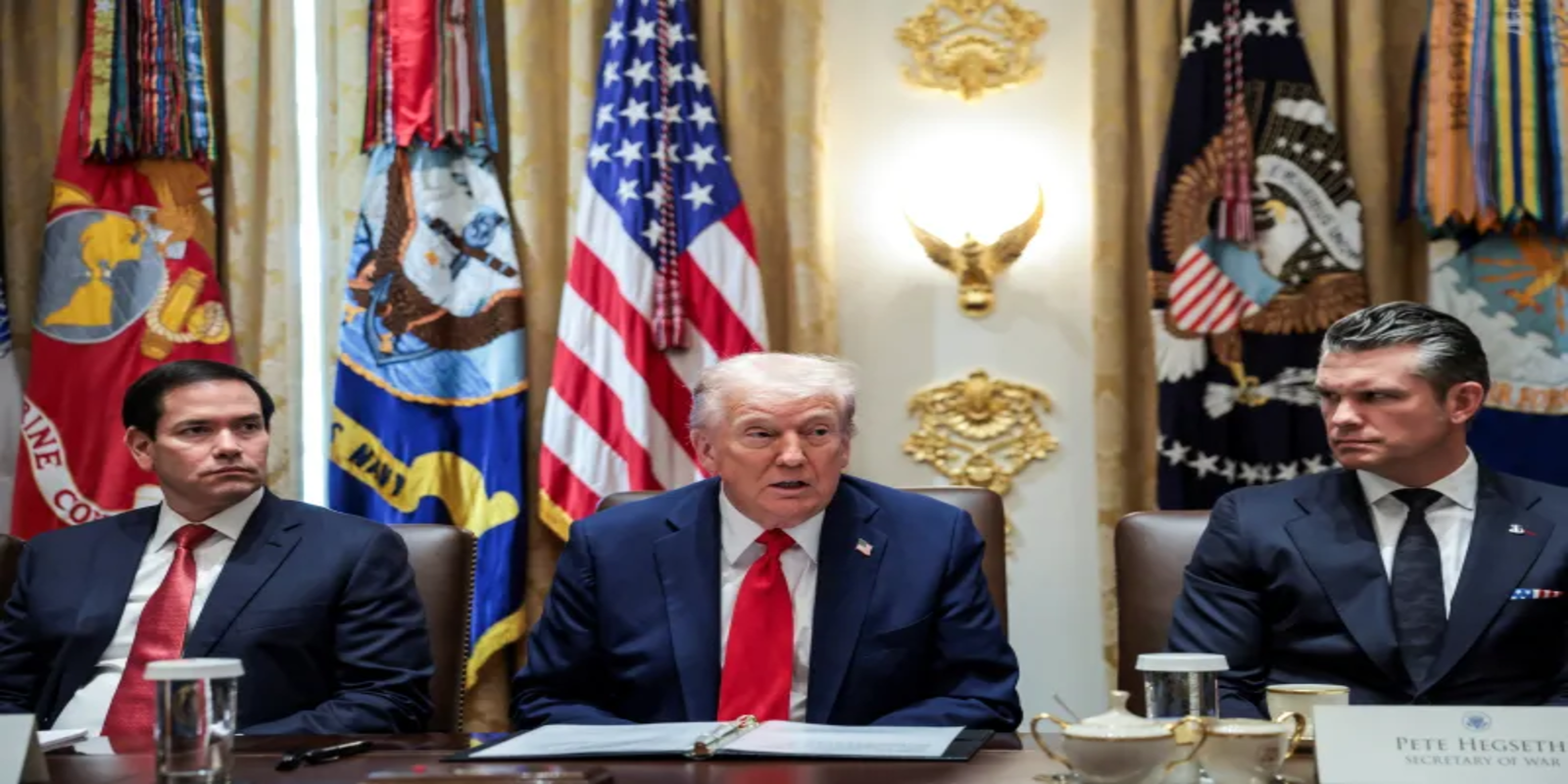
U.S. President Donald Trump, U.S. Defense Secretary Pete Hegseth, and U.S. Secretary of State Marco Rubio announcing a cease-fire in Gaza, Washington, D.C., October 2025 Evelyn Hockstein / Reuters
After the Guns Fall Silent in Gaza
The Tenuous Cease-Fire Between Israel and Hamas
Shira Efron October 10, 2025 Foreign Affairs
This week, U.S. President Donald Trump appeared to accomplish what, for two years, had eluded all previous attempts to end the devastating war between Israel and Hamas. Working closely with Qatar and Turkey, his administration secured commitments from both parties to implement the first phase of a peace plan: an immediate cease-fire and a surge of aid trucks into Gaza, the partial withdrawal of the Israeli military, and the liberation of all the remaining hostages in Hamas’s control in exchange for the release of almost 2,000 Palestinian prisoners held by Israel. Many elements of Trump’s 20-point plan resemble previous proposals. But its near-term tactical brilliance should not be understated. Instead of waiting to declare that an accord had been reached until details had been resolved, his administration locked both warring sides into publicly accepting a deal before they ironed out the specifics of what they had agreed to. At the time of the cease-fire, for instance, Israeli and Hamas teams had not agreed which Palestinian prisoners would be released.
This ambiguity has proved valuable, affording each side a narrative of triumph. Hamas can proclaim that its resistance was vindicated. After the deal was reached, senior Hamas leader Mahmoud Mardawi released a statement proclaiming that “Gaza—the graveyard of invaders—was victorious through its steadfastness and unity, imposing its will on the arrogant enemy,” even as Israel insisted that the agreement forces Hamas’s capitulation by freeing all the hostages, allowing the Israel Defense Forces (IDF) to maintain control over much of Gaza, and requiring Hamas's disarmament. A reprieve is what the Israelis and the Palestinians need, allowing the hostages to return home and the Gazans to begin picking up the pieces of their shattered lives. The images, on Friday, of Israeli soldiers exiting Gaza constitute an incredible relief for both the Israelis and the Gazans. Already during the plan’s first phase, the Palestinian Authority will assume some new powers—for instance, manning the Gazan side of the Rafah border—potentially allowing Israel, which has been staunchly opposed to any Palestinian self-determination, to begin getting used to seeing PA troops under Palestinian flags.
Yet the plan’s deliberate vagueness cuts both ways. By leaving all but the most immediate details out of the first phase, Trump’s plan has created a chasm between phase one and subsequent phases. Without sustained pressure on all the parties and a commitment to address all the thorny issues—including Hamas’s disarmament and Palestinian self-determination—this cease-fire risks becoming merely another interlude before violence reignites.
FEAR FACTOR
The cease-fire’s inherent fragility was already apparent as the initial celebrations began. On Thursday, as Palestinians and Israelis poured into the streets to welcome the news, each of the warring sides continued to needle the other. A Hamas sniper killed an Israeli soldier in Gaza City. The IDF responded with airstrikes that collapsed a building and trapped 40 people under the rubble, characterizing its actions as defensive rather than offensive. Such incidents will likely recur: the IDF’s continued presence in much of Gaza will create numerous flash points that could unravel the entire arrangement.
Hamas has already signaled that it cannot account for all the remains of the hostages who have died in Gaza, an admission that could derail subsequent negotiations. Meanwhile, the agreement’s humanitarian provisions mirror those in January’s failed cease-fire process, promising that 600 aid trucks will enter Gaza daily. That commitment went unfulfilled then, and it faces similar obstacles now. The UN and its partners simply lacked the capacity to reliably send in 600 trucks per day, and bureaucratic bottlenecks imposed by Israel at Gaza’s border crossings further complicated delivery. If either Hamas or Israel seeks a pretext to abandon the negotiations, problems with humanitarian aid could be a convenient justification.
Moreover, according to the plan, the IDF’s full withdrawal from Gaza is supposed to proceed in tandem with Hamas’s disarmament. In practice, however, neither side is eager to comply. Amit Segal, an Israeli journalist close to Israeli Prime Minister Benjamin Netanyahu, has reported that the IDF has no intention of relinquishing control over the 53 percent of Gaza it currently occupies. Israel’s behavior elsewhere supports this assumption: the IDF maintains five positions on Lebanese hilltops despite signing a November 2024 cease-fire deal with Hezbollah, the Lebanese militant group, that required Israeli forces to withdraw. Israel has kept troops in Syria despite U.S. efforts to broker Israeli-Syrian security arrangements. Given that Israel has refused to leave simpler theaters with semi-functioning governments, it is unlikely to withdraw from the far more complex situation in Gaza; continued friction between Hamas operatives and IDF soldiers will only strengthen the Israeli government’s resolve to stay.
Hamas, meanwhile, has said unequivocally that disarmament “should be discussed within a comprehensive Palestinian national framework in which Hamas will be included”—effectively vowing to maintain its arsenal while relegating disarmament to endless consultations. History offers little encouragement. Attempts to disarm Islamist militant groups have consistently failed: the Taliban in Afghanistan, for instance, never genuinely disarmed despite multiple agreements that required them to do so. Hezbollah refused to comply with the disarmament provision in the 1989 Taif accord, which ended Lebanon’s 15-year civil war, and it has rejected every subsequent demand to disarm, including a 2006 UN Security Council resolution promulgated to end its war with Israel.
Hezbollah suffered devastating losses in the fall of 2024, and a new Lebanese government has promised to disarm the militant group. But in August, Naim Qassem, Hezbollah’s current leader, declared that “no one will be allowed to remove the weapons of the resistance.” Israel justifiably fears that Hamas will take the same approach. It may well simply redirect its energies toward clandestinely rebuilding its military capabilities, following the Taliban’s famous formulation: the Americans have the clocks, but we have the time.
NOBODY’S BUSINESS
The next phases of Trump’s framework constitute a larger problem. They resemble previous proposals such as the plan adopted by the Arab League in March, the Biden administration’s formula, and various think-tank blueprints. All these envisioned a postwar situation in which Gaza was managed by a transitional Palestinian government supported by regional and international actors until the PA could reform itself enough to govern. Although these ideas have been in play for many months, as yet there has been no meaningful preparatory work toward reforming the PA.
In the case of the Trump plan, critical questions about governance remain unanswered. Who will staff Trump’s proposed “board of peace” and fill its hundreds of necessary positions? What international organizations will empower the body? There is a flaw in the Trump plan’s structure: it lacks a legitimate Palestinian partner. The agreement envisions a technocratic Palestinian government, yet that government’s participants have neither been identified nor granted legitimacy. The plan establishes no way to achieve the Palestinians’ consent for who will govern them. This creates an untenable situation in which Gaza’s intended governing authority would have no mandate from the population it is meant to serve.
Equally unclear is the question of security. Long ago, mediators struggling to end the terrible war understood that both Palestinian and international peacekeepers will need to take responsibility for securing Gaza. But training such a force has barely begun. The claim that thousands of Palestinian security personnel have completed preparation in Egypt is almost certainly an overstatement. U.S. military officials have opined privately that it could easily take 18 months to build a properly vetted, effective Palestinian security force, and rolling out the next phases of the peace plan cannot wait that long.
Four distinct military forces will be present in Gaza simultaneously.
Standing up an international stabilization force faces equally daunting obstacles. Trump has instructed the U.S. military to establish a command-and-control center within Israel, led by a senior general and staffed with some 200 troops, yet this force will not be designed to enter Gaza. Trump’s plan assumes that Arab and Muslim countries will deploy troops to the strip, and on October 9, Turkish President Recep Tayyip Erdogan declared that Turkey intended to “take part in the mission force that will monitor the agreement’s implementation in the field.” But Israel will almost certainly reject any Turkish security presence in Gaza. This represents merely one example of how regional powers will compete for influence over the implementation of Trump’s plan—and how their conflicting interests could collide.
In reality, Washington’s Arab and regional partners may be much less inclined than some observers assume to want to risk their soldiers’ lives or jeopardize their domestic legitimacy by taking on a mission that will inevitably lead to the deaths of Palestinians. Troops in the multinational force will almost certainly have to be sourced from non-Arab countries. Yet in the absence of a UN Security Council resolution, the force’s composition, mandate, and rules of engagement are entirely unclear.
The plan will likely create a situation in which four distinct military forces are present in Gaza simultaneously: Hamas fighters, Palestinian troops, international peacekeepers, and the IDF. This quartet does not even include other armed clans and factions such as Palestinian Islamic Jihad. No outside country will be eager to deploy its troops into such a volatile environment, particularly when the mission’s objectives remain unclear. For instance, should an international stabilization force engage Hamas fighters if the group fails to fully disarm?
GREAT EXPECTATIONS, GREATER RISKS
A still more fundamental political impasse lies beyond these medium-term implementation challenges. The plan calls for Palestinian self-governance—an objective that Netanyahu has, for many years, explicitly ruled out. Israeli leaders may simply believe that what the plan calls a “pathway to Palestinian self-determination and statehood” will never come to fruition, judging it to be conditioned on reforms that the PA will not enact. But the Arab countries on the hook to underwrite Gaza’s stabilization—a project that the UN has estimated will cost over $53 billion—expect that Trump will deliver on this pathway. In welcoming the cease-fire, the Saudi Foreign Ministry released a statement pointedly emphasizing its belief that the plan must “initiate practical steps to achieve a comprehensive and just peace based on the two-state solution” and move toward establishing an independent Palestinian state “with East Jerusalem as its capital.”
The PA has maintained certain functions even throughout the war that will likely expand. Ramallah’s water authority, for instance, has continued to manage Gaza’s water and sanitation infrastructure. The PA could incrementally assume more governance roles in a tacit “don’t ask, don’t tell” arrangement, demonstrating to Israel that the PA’s presence in Gaza need not precipitate catastrophe and ensuring that Arab countries remain committed to providing material and political support for the agreement. But success will require delicate diplomatic choreography and sustained pressure on every stakeholder.
If some form of technocratic governance emerges, it could enable real reconstruction to commence and allow Israeli and Palestinian societies to begin addressing their trauma and losses. From a humanitarian perspective, even limited success would be profoundly important. By setting realistic expectations, and by enforcing a willingness on all sides to navigate inevitable setbacks and accept that partial implementation is better than none, the plan’s guarantors might gradually overcome these formidable obstacles. But the most demanding work begins now.