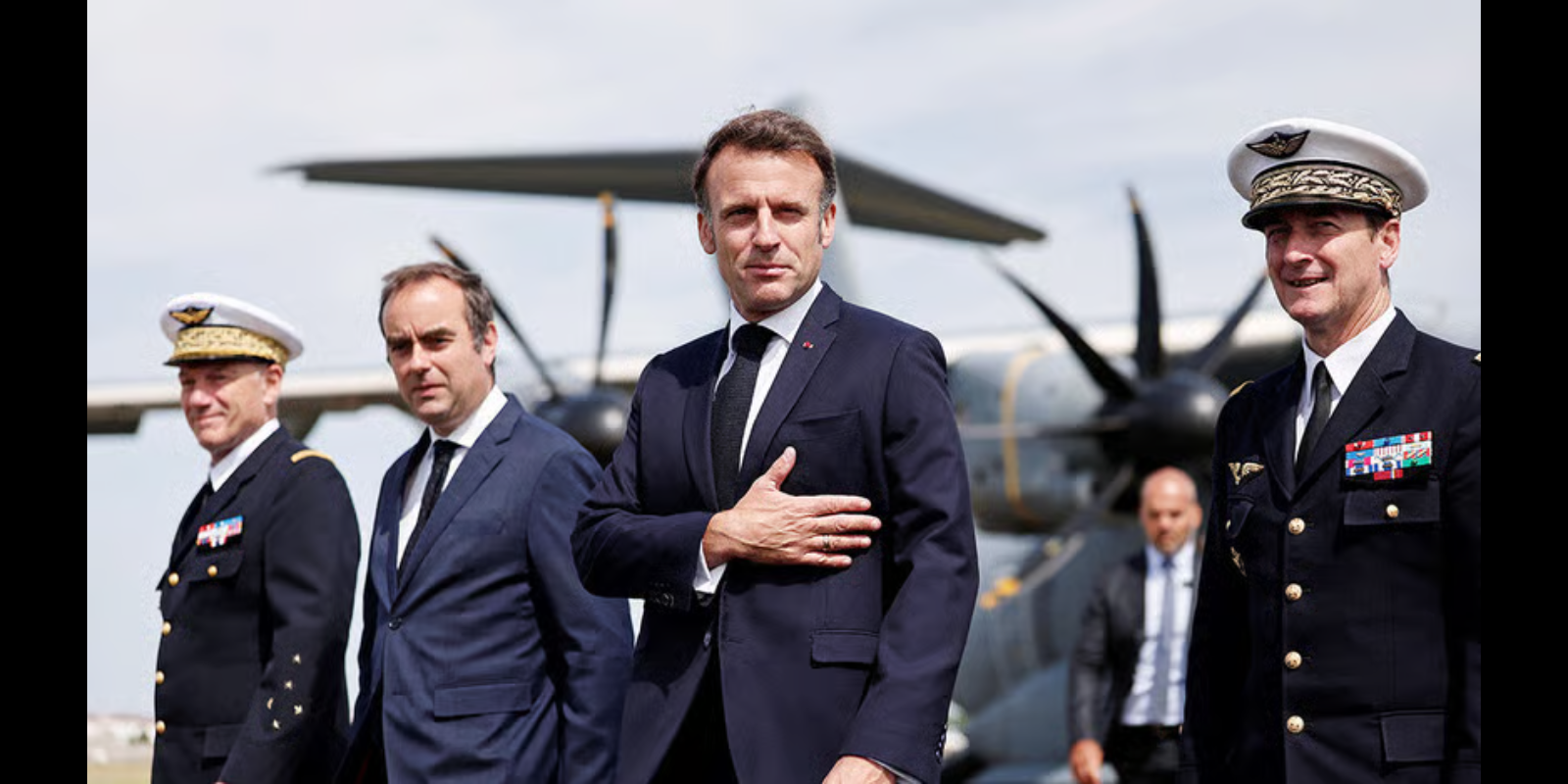
President Emmanuel Macron visits the Paris air show Photograph: EPA/Shutterstock
Europe | French defence spending
Macron was right about strategic autonomy
But France lacks the means to pay for much of it
The Economist Jul 24th 2025
NUUK AND PARIS
On a chilly June day off the coast of Greenland, Emmanuel Macron, France’s president, and Mette Frederiksen, Denmark’s prime minister, boarded a Danish warship in a show of defiant solidarity. It was a cheeky piece of diplomacy. Mr Macron’s “hands off” message was partly directed at America’s Donald Trump, who has threatened to annex the Danish territory. “Greenland is not to be sold, not to be taken,” Mr Macron declared. But the French president’s message was also intended for Europeans: they need to stick together, stand up for themselves and stop clinging to dependence on America.
Ever since he was first elected in 2017 Mr Macron has pushed the idea of European “strategic autonomy”. For years it was brushed aside politely by France’s Atlanticist neighbours as fanciful Gaullist grandeur, if not a brazen attempt to undermine the transatlantic alliance. But Mr Trump’s return to the White House and his disregard for Europe have jolted the continent’s leaders. Even Friedrich Merz, the German chancellor, has urged Europeans to “achieve independence” from America.
For France, however, the moment reveals an awkward paradox. It turns out that Mr Macron was right about what Europe needs to do. Yet the country is among the continent’s least well placed to finance it. Germany, France’s main European Union partner, has the fiscal space to pay for its planned defence rise. But France is already squeezed. In 2025 its budget deficit will reach 5.6% of GDP, according to the European Commission, and its public debt 116% of GDP, behind only Greece and Italy. If France is to raise defence spending from 2% to 3.5% of GDP by 2035, as agreed at a recent NATO summit, this would imply more than doubling the 2024 defence budget in current terms—an increase of nearly €80bn ($94bn).
The good news is that there is a fairly broad consensus for spending more on defence. Over two-thirds told a recent poll that they were in favour of a bigger defence budget. Even a narrow majority of supporters of Marine Le Pen’s hard-right National Rally (RN) approved. A broad swathe of political parties, from the Socialists to the Republicans, are also generally in favour of an increase in defence spending.
Yet the politics of doing this are nonetheless tricky. Mr Macron runs a fragile minority government, under the centrist François Bayrou. On July 15th, declaring that it was a “moment of truth” for French public finances, Mr Bayrou announced €44bn of savings in 2026 to curb the deficit to 4.6%. These include cancelling two public holidays and a freeze on all budgets, including social spending, except defence. Days previously, stating that “since 1945 freedom has never been so threatened”, Mr Macron promised that the defence budget would get an extra €6.5bn over two years.
The trouble for Mr Bayrou is that even this will be difficult to pass. On July 1st he survived an eighth vote of no-confidence; the Socialists voted against the government, the RN abstained. “The political equation is very messy,” says one of Mr Macron’s deputies. “The prime minister is mainly trying to survive.” More such votes are likely in the autumn, when the budget for 2026 goes to parliament. Mr Bayrou’s government could be toppled.
As ever, France hopes to resolve part of the problem by sharing it with EU friends. A report in May by the government’s strategic-planning advisory body argued for joint European borrowing for defence as a way to complement a domestic budgetary effort. “There is no quick fix,” says Clément Beaune, its head and a former Europe minister. “But, for the first time in the history of the EU, everyone realises that there is a common threat and a common need to rearm.” Given Russian rearmament and American unreliability, says Camille Grand, a former assistant secretary-general at NATO, common borrowing would be a “very good” scenario for both France and European collective defence.
Raising joint debt for defence, however, would run into firm opposition from Europe’s “frugals”, led by Germany. Such friends might be convinced, argues Mr Beaune, if France can show it is making a budgetary effort at home. Yet Mr Bayrou’s plans have already been met by howls of protest. Ms Le Pen called them “intolerable”. Olivier Faure, the Socialist leader, denounced a “demolition” of France’s social model. Indeed, this year’s main political debate has concerned not how to streamline social spending, but whether to bin Mr Macron’s pension reform. Pushed through in 2023, this raised the legal minimum retirement age from 62 years to 64.
For Mr Macron, who is in office until 2027, this is a source of frustration and disappointment. He recognises in private that he has failed to create the consensus needed to get the country to accept that strategic autonomy, while popular, requires an effort. The French like independence, but not having to make sacrifices for it. “I just don’t see how France can reach the defence-spending target without European money,” says Mujtaba Rahman, European head of Eurasia, a risk consultancy.
The contrast with Denmark is revealing. It has shifted, painfully, from a reliance on America’s security umbrella to massive rearmament; defence spending should reach 3% of GDP this year. At the same time Denmark is raising its retirement age to 70 years, Europe’s highest. The architect of these changes, Ms Frederiksen, spent much time talking to Mr Macron on glaciers and fjords in Greenland. The difference between them was stark. One had the right idea; the other has found a way to put it into practice. ■