Russian Strategic Bombers Destroyed In Unprecedented Wide-Scale Drone Attack
The attacks that went after the heart of Russia's strategic aviation capabilities and one arm of its nuclear deterrent should serve as a global wake-up call.
Howard Altman, Tyler Rogoway Jun 1, 2025
Ukraine carried out a massive drone strike at airbases across Russia on Sunday, claiming to have destroyed dozens of aircraft. There are also indications that Russia’s Northern Fleet headquarters, home of Russian nuclear submarines, was attacked as well. Overall, the attack was clearly aimed at Russia’s most prized strategic aerial assets, which cannot be replaced quickly in any manner and doing so at all would be extremely expensive.
“The Security Service of Ukraine is conducting a large-scale special operation to destroy bomber aircraft in the rear of the Russian Federation,” the Ukrainian Armed Forces General Staff stated on Telegram. “SBU drones have hit more than 40 aircraft, including A-50, Tu-95 and Tu-22 M3, causing damage of over $2 billion.”
The operation, codenamed “Web,” targeted four key Russian airbases: Belaya, Diaghilevo, Olenya and Ivanovo, the Kyiv Post reported.
There was no immediate response from Russian officials.
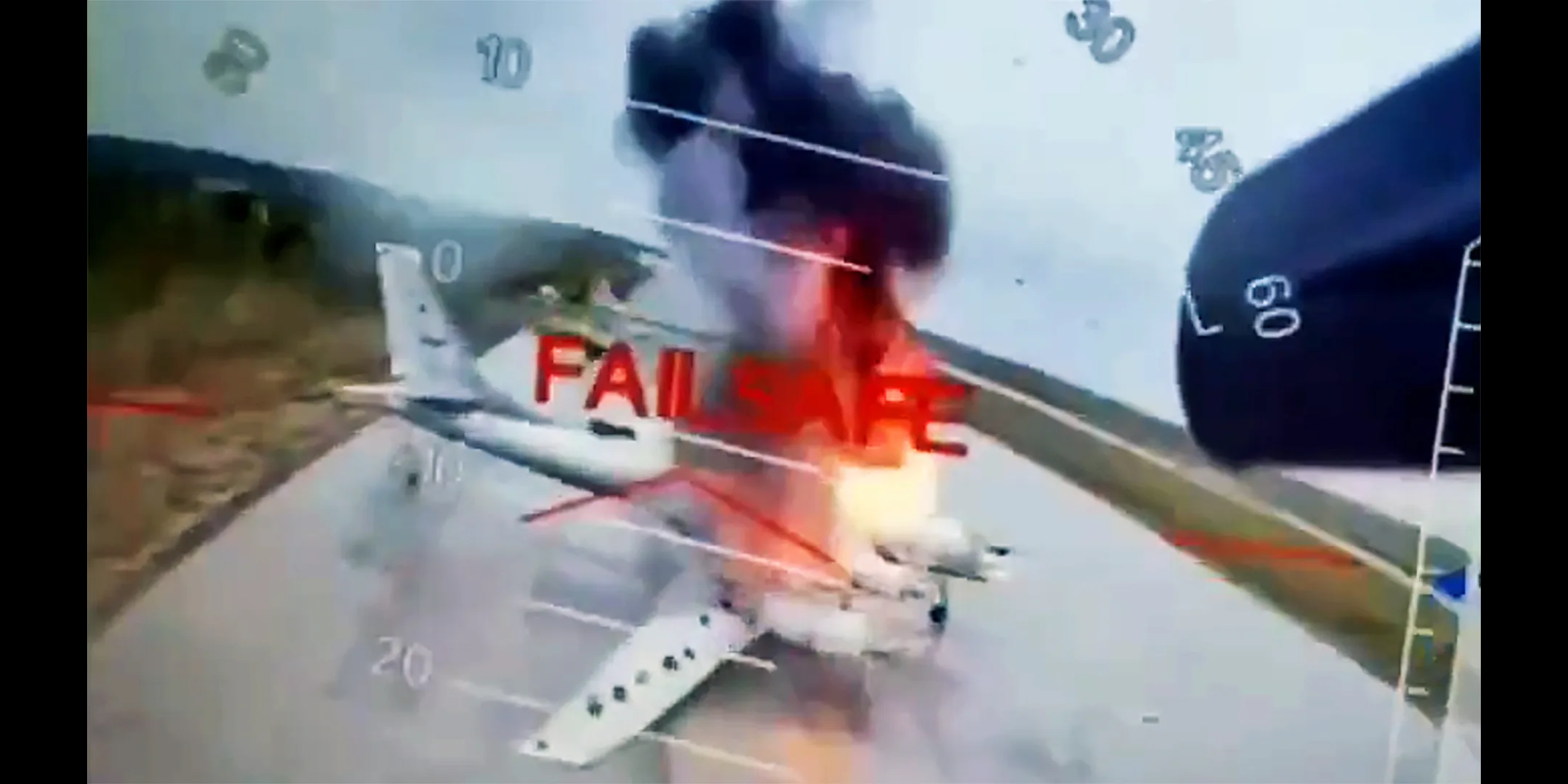
While The War Zone cannot independently verify these claims, video has emerged showing Russian bombers being struck by drones. We have geolocated the video to show that the attack was on the Olenya base, even though it was widely reported as the Belaya Air Base in Irkutsk.
Multiple videos show that the attacks apparently came from first-person view (FPV) drones launched from trucks parked nearby.
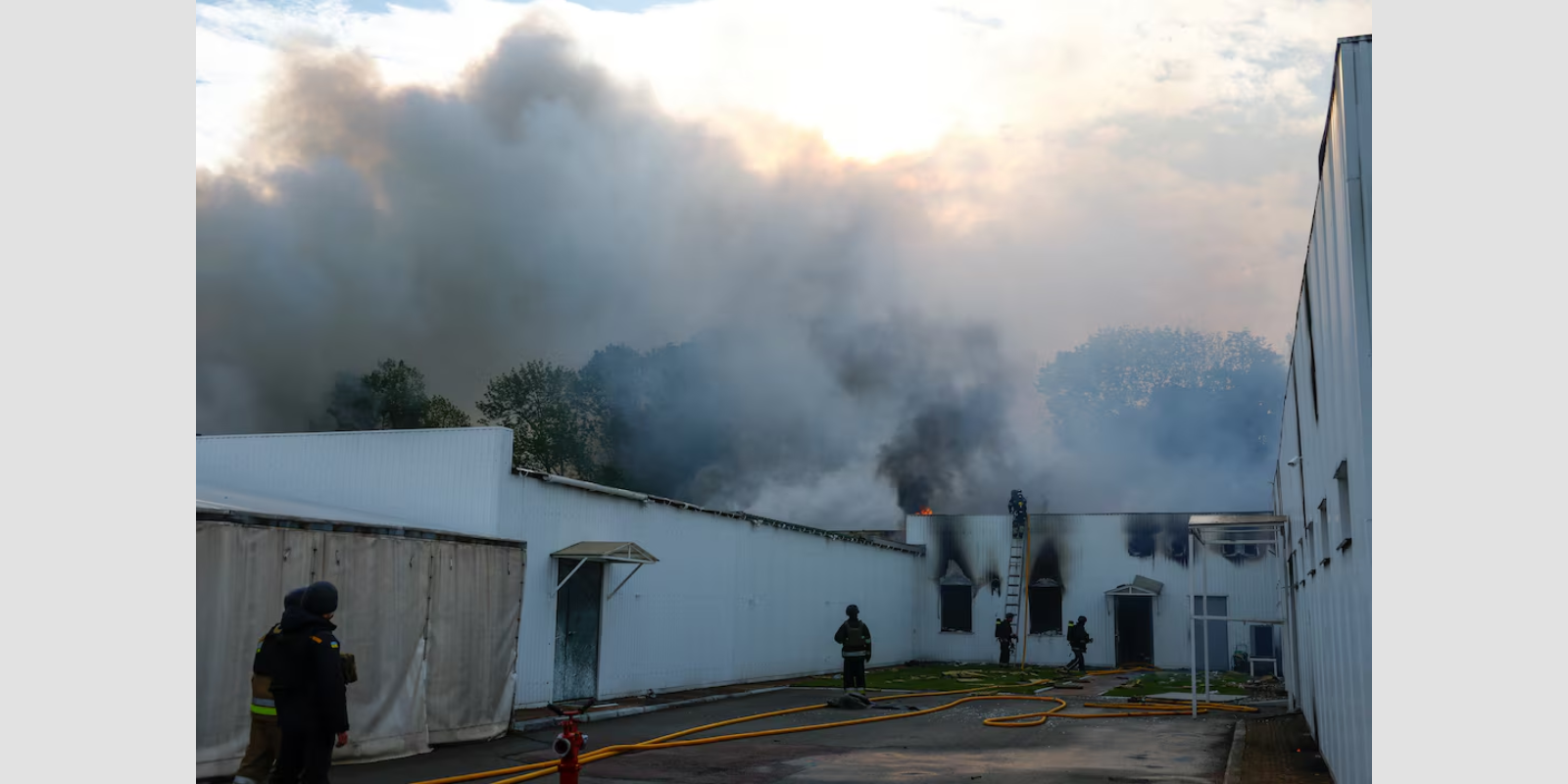
The Russian air base in Olenegorsk, Murmansk, was also attacked.
Explosions and flames were observed at Russia’s Northern Fleet headquarters in Murmansk. It is home to some of Russia’s most capable submarines, like the Yasen-M class nuclear-powered cruise missile carrying Kazan.
Russian officials denied that the Northern Fleet headquarters was attacked.
“The information about explosions in Severomorsk, which is being spread on social networks, does not correspond to reality,” the head of the city said, according to the Russian Operation Z Telegram channel. “The situation is currently stable. No threats have been recorded. Do not panic and trust only verified sources of information!”
As all of this was taking place, the Ukrainian Armed Forces General Staff said Russia conducted one of its biggest attacks of the war, launching 472 drones and seven ballistic and cruise missiles across the country. Ukraine says it “neutralised” 385 aerial targets.
Broader Context
As we noted in the opening of this story, the fact that Ukraine went after some of Russia’s most prized aerial capabilities, many of which are directly tied to its nuclear deterrent, greatly ups the ante. We don’t know how many strategic aircraft Russia lost today, but it could be a large portion of its long-range cruise missile carrier aircraft. While these aircraft have rained destruction on Ukraine from afar and are legitimate targets, they also underpin a leg of Russia’s nuclear deterrent. This will undoubtedly provoke a unique response from the Kremlin who has warned that widespread attacks against its strategic capabilities would be a red line.
The threat of wide-scale, low-end, localized drone attacks against prized aircraft sitting at airfields — including in the U.S. homeland — has been a brewing threat, as TWZ highlighted repeatedly for many years, which includes the exact scenario that occurred in Ukraine in the last 24 hours. Drone technology has proliferated dramatically since, and the threshold requirements for executing such an attack have dropped considerably. At the same time, defenses against these types of threats still lag behind, both in wartime Russia and most everywhere else.
This is also a glaring case of how the lack of any kind of hardened shelters leaves aircraft totally exposed to attack., which is another reality TWZ has highlighted for years, but still has not changed the U.S. investment strategy in this kind of infrastructure, even at forward locales in the Pacific. Meanwhile, drone incursions of U.S. bases at home and abroad — another issue TWZ reported on exclusively for years — have shown just how vulnerable even the Department of Defense’s most prized and critical aerial assets are.
There is also artificial intelligence-enabled low-end drones now becoming a reality. This would allow these aircraft to fly much farther without any radio control and hit targets they recognize autonomously. You can read all about that major development and its massive implications, which have been spurred by the war in Ukraine, here.
It is unclear what control method the drones used to strike aircraft at these bases were. FPV types with a human-in-the-loop nearby are possible, as are ones programmed to hit precise GPS coordinates. Both have major advantages and glaring vulnerabilities. AI-enabled ones that use image matching are possible too, which would allow the strikes to occur without emitting radio-frequency emissions and without the chance of the drones being jammed. The drones would also not require individual controllers and, like those programmed to hit GPS coordinates, they could be launched and strike in rapid succession. Russia has been covering their aircraft with tires in hopes of confusing image-matching autonomous drones in case of this kind of attack, which the TWZ was first to report on.
The Russian Defense Ministry (MoD) commented on the attacks.
“Today, the Kyiv regime carried out a terrorist attack using FPV drones against airfields in the Murmansk, Irkutsk, Ivanovo, Ryazan and Amur regions,” the MoD stated on Telegram. “At military airfields in the Ivanovo, Ryazan and Amur regions, all terrorist attacks were repelled. In the Murmansk and Irkutsk regions, as a result of the launch of FPV drones from the territory located in the immediate vicinity of airfields, several units of aircraft caught fire.”
The fires “have been extinguished,” the MoD added. “There are no casualties among military personnel or civilians. Some of the participants in the terrorist attacks have been detained.”
Ukrainian President Volodymyr Zelensky “personally supervised the operation, and Vasyl Malyuk and the SBU team implemented the plan. 41 Russian strategic aviation aircraft were hit,” Ukrainian journalist Sergey Bratchuk wrote Telegram. “According to sources, this operation was extremely difficult from a logistical point of view. The SBU first transported FPV drones to Russia, and later – mobile wooden houses. Later, in the territory of the Russian Federation, the drones were hidden under the roofs of houses already placed on trucks. At the right moment, the roofs of the houses were remotely opened, and the drones flew to strike Russian bombers.”
Sources in the SBU “emphasize that the people who participated in this historic special operation have been in Ukraine for a long time,” Bratchuk added. “So, if the Putin regime demonstratively detains someone, it will be another staged operation.”
Irkutsk Oblast Governor Igor Kobzev confirmed that drones were launched from a truck.
“At the moment, it is known that this was a drone attack on a military unit in the village of Sredniy,” he stated on Telegram. “The source from which the drones were launched has already been blocked. It’s a truck. The main thing is not to panic. There is no threat to the lives and health of civilians.”
Meanwhile new video emerged of the attack on Olenya.
The large-scale attack comes ahead of a scheduled meeting in Istanbul that is part of ongoing peace talks.
“We are doing everything to protect our independence, our state, and our people,” Zelensky said on X. “I outlined the tasks for the near term and also defined our positions ahead of the meeting in Istanbul on Monday. First – a full and unconditional ceasefire. Second – the release of prisoners. Third – the return of abducted children. And in order to establish a reliable and lasting peace and ensure security, preparation of the meeting at the highest level. The key issues can only be resolved by the leaders. On Monday, our delegation will be led by Rustem Umerov.”