
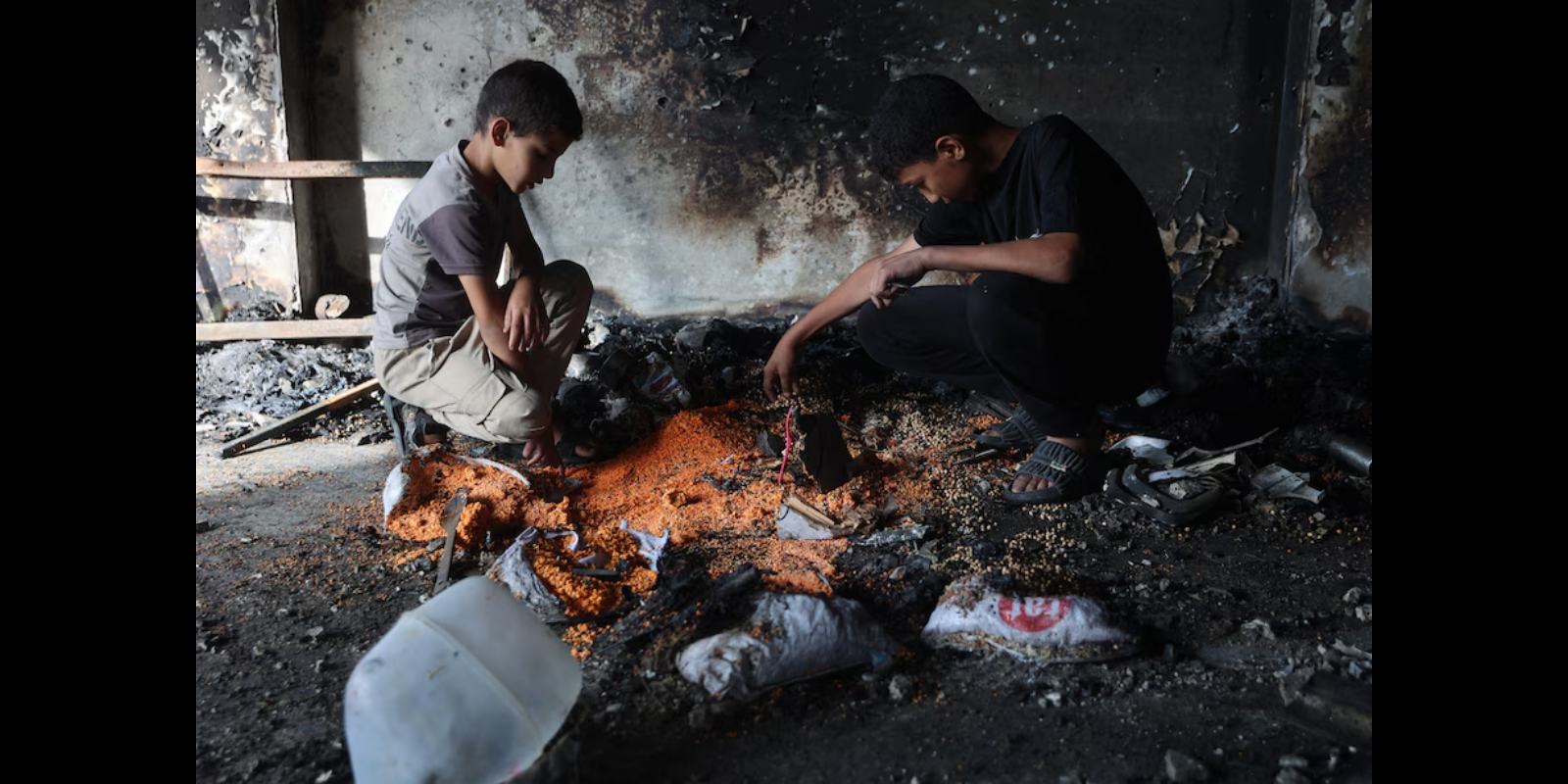
Palestinian children look through burned sacks of grain Tuesday after an Israeli airstrike hit a school in Gaza City. (Omar Al-Qattaa/AFP/Getty Images)
Israel’s plans for Gaza draw rebuke, review of trade ties from allies
Britain suspended trade negotiations and the E.U. pledged to review ties as Israel’s siege of Gaza tested the limits of some of its closest European partners.
By Ellen Francis, Abbie Cheeseman, Claire Parker and Steve Hendrix
The Washington Post 20-05-2025
BRUSSELS — Israel was under mounting pressure Tuesday over its war in the Gaza Strip as key allies, including Britain and European Union member states, either suspended free trade negotiations or pledged to review commercial ties, warning the Israeli government that it needs to end a renewed military offensive and allow the unfettered flow of aid into the enclave.
The British government said in a statement that it would adhere to an existing trade pact with Israel but that the “egregious policies” of Israeli Prime Minister Benjamin Netanyahu in Gaza and the West Bank have made it impossible to “advance discussions” on a potential new accord. It cited Israel’s 11-week blockade on Gaza, where more than 2 million people are now at critical risk of famine, as well as a new ground operation Israeli officials have said will include taking all of the Gaza Strip’s territory.
In Brussels, E.U. foreign policy chief Kaja Kallas announced that the bloc of 27 countries would begin a formal review of its trade accord with Israel. A “huge majority” of E.U. foreign ministers backed a proposal to reconsider the deal, which includes provisions on international human rights law, Kallas said at a news conference.
“So we will launch this exercise, and in the meantime it is up to Israel to unblock the humanitarian aid,” she said.
A spokesman for Israel’s foreign ministry, Oren Marmorstein, said Kallas’s remarks reflected “a total misunderstanding of the complex reality Israel is facing.”
“Ignoring these realities and criticising Israel only hardens Hamas’s position and encourages Hamas to stick to its guns,” he wrote on X.
The steps by both London and Brussels on Tuesday were a sign of the shifting attitudes among longtime supporters of Israel as it prepared to implement plans, backed by the United States, to displace Gaza residents to enclaves in the south. There, the Israeli military and U.S. security contractors would control the delivery of aid through distribution hubs and maintain strict limits on food.
In remarks to Parliament on Tuesday, British Foreign Secretary David Lammy described the plans as “repellent,” “monstrous” and “morally unjustifiable.” He said Israeli Ambassador Tzipi Hotovely was summoned to the Foreign Office to be told formally that the British government considers the blockade to be “cruel and indefensible.”
Netanyahu had made a surprise announcement late Sunday saying he had authorized a “basic quantity of food” to enter Gaza at the recommendation of the military. Then, on Monday, he said he made the decision under pressure from Israel’s allies, including the United States, whose politicians he described as not being able to “handle pictures of mass starvation.”
Appearing before the Senate Foreign Relations Committee on Tuesday, Secretary of State Marco Rubio faced an emotional line of questing on Gaza from Democratic lawmakers, with some arguing that the Trump administration had done little to pressure Netanyahu.
“Not once did you publicly call on the Netanyahu government to end the blockade. Fortunately other countries spoke out and now we see a tiny trickle going in,” said Sen. Chris Van Hollen (D-Maryland).
Sen. Jeff Merkley (D-Oregon) asked if the Trump administration was conveying to Netanyahu that “encouraging migration through food denial is an unacceptable strategy?” Rubio did not answer the question directly but said the administration was glad food was getting in, though he admitted it may not yet be sufficient.
“I don’t think you would have seen the events of the last couple of days without our engagement and the engagement of others,” Rubio said, referring to Israel’s move to allow food to enter Gaza.
Israeli authorities had told aid agencies they would be able to send 100 trucks per day into Gaza from Monday until Friday, representing about 500 trucks in total, three humanitarian officials told The Washington Post.
Relief groups have said far greater numbers of trucks are needed to address acute hunger in Gaza. Before the war, an average of 500 trucks would enter each working day, or roughly 10,000 trucks a month, according to the U.N. Office for the Coordination of Humanitarian Affairs (OCHA).
“There are thousands of trucks. This humanitarian aid is financed by the E.U., and that’s why the members states are also very keen on sending this message,” Kallas said.
At least five trucks carrying baby food and nutritional supplements were cleared Monday to enter the territory, the United Nations said, but on Tuesday, U.N. spokesman Stéphane Dujarric said the organization’s team “waited several hours for [the] Israeli green light to access … and collect the nutrition supplies.”
“Just to make it clear, while more supplies have come into the Gaza Strip, we have not been able to secure the arrival of those supplies into our warehouses and delivery points,” Dujarric said at a press briefing.
Israel says the harsher measures are aimed at pressuring Hamas to release the remaining hostages it abducted on Oct. 7, 2023. Those attacks killed nearly 1,200 people, including around 300 soldiers, and saw more than 250 others taken to Gaza as hostages, according to Israeli authorities.
Since then, Israel’s military campaign has killed more than 53,000 people in Gaza, according to the local Health Ministry, which does not distinguish between civilians and combatants but says the majority of the dead are women and children. Israel’s invasion leveled the enclave, displaced the majority of the population and gave rise to a humanitarian catastrophe, including a lingering hunger crisis.
But hopes on Tuesday for a potential ceasefire dimmed, as Netanyahu said he was pulling Israel’s senior negotiating team from indirect talks with Hamas in Qatar, which has played a mediating role. The two sides have negotiated on and off for months to end the war, but while Hamas wants a permanent ceasefire and the withdrawal of Israeli troops, Israel still wants the ability to resume fighting if necessary and says Hamas should release the remaining 58 hostages, 23 of whom are believed to be alive, without conditions.
“There is a fundamental gap between the two parties,” Qatari Prime Minister Mohammed bin Abdulrahman Al Thani said.
Israel blamed Hamas for the stalemate Tuesday. “Hamas will pay the price for its refusal — it will face the full force of our firepower,” the Israeli military’s chief of staff, Eyal Zamir, said Tuesday. “We will expand the ground maneuver, seize more territory, and cleanse and destroy the terror infrastructure until Hamas is defeated.”
Israeli attacks killed at least 53 people in Gaza on Tuesday, according to the Health Ministry. Local media reported a particular focus on hospitals in northern Gaza, and videos shared by medics at the Kamal Adwan Hospital showed people flooding in after what the director, Sakher Hamad, said was a strike on a nearby school.
Bloodied patients were splayed across the floor because of the limited number of beds. The hospital also came under tank fire overnight, Hamad said, adding that it was compounding staff shortages, with many scared that Israeli forces will soon enter the hospital.
The military said Tuesday that it had hit “more than 100 terrorist targets” overnight. The heavy bombardment is part of the opening salvo of what Israel has called Operation Gideon’s Chariots, the military offensive launched last week. In just a matter of days, the operation has displaced 97,000 Palestinians, Olga Cherevko, spokeswoman for OCHA in Gaza, said in an interview late Monday.
“People are being told to move, and they move thinking they will find a safer place — and then those places are bombed again,” she said. “The ones who are getting displaced over and over again, they’re running without anything. They’re sleeping in the streets. They’re running with just the shirts on their backs, basically.”
Israeli officials have largely condemned the pressure they see mounting from Europe, including on Monday when Britain, Canada and France issued a statement threatening “concrete actions” if Israel did not reverse course in Gaza. Netanyahu said the warning was a “huge prize” for Hamas.
“Opposing the expansion of a war that has killed thousands of children is not rewarding Hamas,” Lammy told lawmakers in London. “The world is judging, history will judge them,” he said, referring to Israel’s government.
While the measures by Britain and the E.U. sent a signal to Israel, it wasn’t immediately clear what the potential impact would be. Britain and Israel already have a free trade agreement, and for the E.U. to actually suspend ties with Israel, that would require unanimity in the bloc, which so far appears lacking. The E.U. is Israel’s biggest trading partner, but its member states have been split on using such levers as pressure, with little appetite from Israel’s staunch backers, including Germany.
France, however, has taken a leading role in pushing Netanyahu on Gaza, angering Israeli leaders.
Before the vote in Brussels, French Foreign Minister Jean-Noël Barrot told the public radio station France Inter that his country supported a review of E.U. trade ties and that the number of aid trucks now sent into Gaza was nominal after an almost three-month blockade that has left “the children of Gaza starving.”
“For interior political reasons, the Israeli government has decided to crack open the door, but it’s totally insufficient,” Barrot said Tuesday. “The blind violence and the blockade of humanitarian aid by the Israeli government have turned the enclave into a death trap. This must stop. … It is an absolute violation of all the rules of international law.”☀
Cheeseman reported from Beirut, Parker from Jerusalem and Hendrix from London. Suzan Haidamous and Mohamad El Chamaa in Beirut and Adam Taylor in Washington contributed to this report.